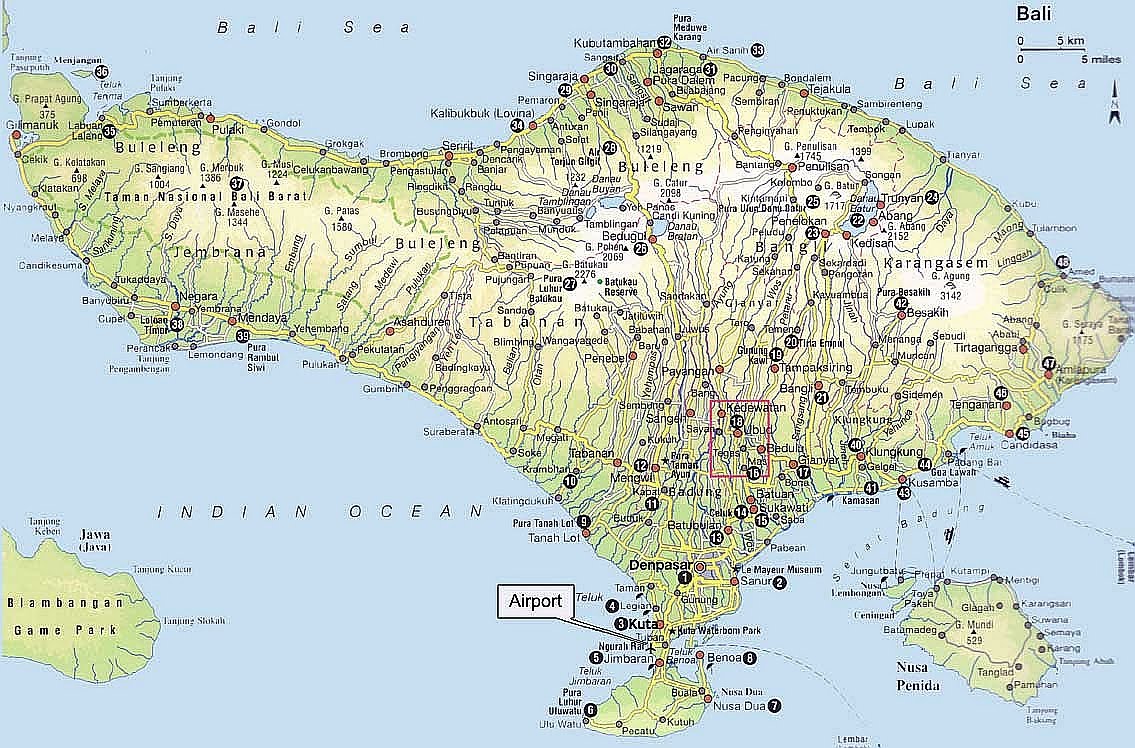
The Nomadic Nixons (Bali by bicycle)

Interesting article about Bali by cycling, from http://nomadicnixons.blogspot.com/2010_06_01_archive.html


Green Bicycle.

My girlfriend cycling in Bali.

My "HUMMER" bicycle.

Bali by bicycle - It was tough, it was wet, but Andrew Bain found unexpected delights pedalling around Bali

Bali by bicycle : article from: http://www.smh.com.au/articles/2004/04/16/1082055633667.html

The lush steep steppes of Bali provides a challenge for even the most determined cyclist.

It was tough, it was wet, but Andrew Bain found unexpected delights pedalling around Bali.

The road is a river, awash with monsoonal rains. The midday sun has darkened to a candle of light and thunder resounds like cannon fire across the sullen Bali sky.

"It is God's music," Wayan assures me from inside the shelter of his roadside stall, and for him the weather is indeed a divine blessing. I am the first traveller in months to stop at his store on the outskirts of the city of Gianyar, marooned here in my sodden clothes and with my mythically deep tourist pockets. I order a second drink and another stormy hour passes.

Out in the bitumen stream a prehistoric bicycle splashes past, its rider bared to the rain but for a pair of saturated trousers that cling to his grasshopper-thin legs. Such stoicism shames me, huddled as I am in the comfort of this temporary asylum. I make my farewell to a disappointed Wayan, who assures me I am both strong and crazy, and head back out into the rain and onto my own dripping bicycle.

"You are like Neil Armstrong," Wayan proclaims, though he means Lance Armstrong, since I've just told him of my intention to cycle around Bali.

My journey had begun in Denpasar just a few hours before. If there is safety in madness it is here, cycling in the turmoil of Bali's largest city. Traffic spins as wildly as a centrifuge, trucks, cars, motorbikes, pushcarts, dogs, pedestrians and chickens doing as they please. It's disorder that's accustomed to disorder, Asia condensed to a small island, and my bicycle barely registered in its mind. I was just another pothole or chicken to be driven around.

Horns sounded without end, but within an hour I'd learned to ignore them, their language more foreign to me even than Indonesian. They seemed to say nothing and everything - hello, watch out, move aside, good luck or, simply, I have a horn. Trucks lumbered by but only one came near to hitting me, a truck named God Bless II that almost blessed me head-on.

Denpasar sprawled east to blur into Gianyar, the roadside an unholy alliance of temples, urban rice fields and stores advertising Playstation rental and the machismo of cigarettes. Quickly it became apparent that the beaches, volcanoes and lush rice terraces that monopolise Bali's tourist image would not be the cyclist's reality, fading to secondary status behind the endless string of village life. Each time I stopped for a rest, motorbikes pulled in alongside, asking the question I'd answer dozens of times each day.

"Where you go?"

Any reply would suffice. Sometimes I'd name the next village, city or tourist attraction. Other times I'd get bolder.

"To the moon," I told one motorcyclist in Gianyar, delighting in my new kinship with Neil Armstrong.

"Very good, sir."

To the continued accompaniment of God's thunderous tune I turned inland at Gianyar, onto the fertile slopes of Bali's highest and most sacred volcano, Gunung Agung. Settlement and the road snaked up the volcano and into the former royal city of Bangli. Billed by one local book as the "Cinderella of Bali tourism", Bangli is bookended by great temples: Pura Dalem Penunggekan and Pura Kehen, the island's second-largest temple, stepped into a hillside above the city. Kehen is tourist central for Bangli, yet almost every one of the souvenir stalls at its edge was shuttered. That night, I would be the only guest at either of Bangli's two hotels.

"Bali many problems," a man at Pura Kehen's entrance told me. "Bomb." And so began another discussion that echoed through my days on the island: the Kuta bombing.

Not once did I dig at Balinese memories of the blast, but they lay scattered and exposed like rubble. That night, I heard music in the street below my hotel room - guitar, tambourine and wonderfully raucous, harmonising voices. Balinese songs broken by a recurring rendition of La Bamba. I wandered outside and sat on the kerb to listen. Within minutes I was invited over for a beer and a song.

"Three years ago Bangli had many tourists, but now there are none," one of the singers explained, his face hardening like stone. "F-- Amrosi. F-- terrorist." F-- terrorist, the others sang. The same words followed me from conversation to conversation, village to village. English-speakers or not, it seemed that everybody knew this one fervent statement.

In Bangli the night never stilled and I slept fitfully. Dogs fought in the street, roosters called impatiently and people rose to begin their long days. Finally, so did the sun, etching Gunung Agung black onto the dawn sky, its peak almost 3000 metres above the city. That day my punishment would be to contour across the mountain's ribbed slopes, riding a rollercoaster of lava flows towards the island's east coast. My reward for this effort would be to disappear into the verdant folds that held some of Bali's most attractive rice terracing.

Cattle ploughed the terraces and workers stood from their river baths, immodest about their nudity, to wave as I passed.

"Where you go, sir?" they'd call, and I'd just point ahead. On through this terraced country seemed as good as anywhere.

The road crested at around 600 metres above sea level, the rice fields suddenly behind and below me and a tropical cornucopia ahead. The forest thickened and filled with rambutan, papaya, banana and salak, the Balinese "snakeskin" fruit that would virtually fuel my journey. My panniers became heavy with fruit, an anchor for what would become a difficult next day.

My plan for that day was to reach the once-burgeoning east-coast resort of Amed, only 14 kilometres from where I slept in Tirta Gangga. It could have been so easy. Instead, I doubled back and turned onto the little-used coastal road that rounded Bali's eastern tip. Fifty kilometres later I'd be cursing the most trying day of my journey.

I joined the coast at Ujung, site of an elaborate water palace, its pools now more popular with local anglers than tourists. From here the road pointed up, not following the coast at all but ascending onto the slopes of the volcano Gunung Seraya.

Through Seraya village the road climbed 200 metres, sweat pouring from my body in the relentless humidity, making me wetter than I'd been in some downpours. The money in my pockets turned soft with moisture. So much for the luxury of the coast, which I sighted only through breaks in the forest, glimpses of gorgeous, faraway shores and tiny villages as remote as the Sea of Tranquillity.

Word spread along the road of my slow passage, and children ran from their homes and schools to wave and call. I was cheered, jeered and even horse-whipped by one importunate boy, but always - as had become customary - I was called "sir".

On I climbed, the road narrowing to a pencil line, devoid of almost anything but foot traffic. The landscapes changed - cornfields replacing rice on these drier, steeper slopes - and so did my welcome.

Young children suddenly ran from me, scrambling terrified into the cornfields. Babies wailed and dogs scattered. What sort of strange place was this eastern tip of Bali that dogs ran from cyclists and not after them?

It was as though I was a pioneering tourist on this far-flung nib of land, but I clearly wasn't. In an instant my name changed from "sir" to "pen" and "cigarette" as children and youths shouted their demands for handouts. On uphill stretches of road they ran alongside the bike, keeping pace, yelling, screaming, threatening at times. For two hours I shook my head at almost everybody I passed, my mood becoming as black as the beaches to which I was heading.

At Amed's edge I passed a final group of youths, my head down to avoid contact, but still they turned to stare. "Have a nice trip," one called and waved me on. The words hit me like a cool wind, blowing off my sweat and anger.

In Amed, fishing and tourism appeared to have struck an uneasy balance. Here, as yet, it had been impossible to replace island reality with the sterility of a resort strip. Fishermen's hovels lined the beaches, little more than roofs without walls, their toilets cut into the sand, awaiting the flush of high tide. Fishing boats were stacked so thickly that the beaches beneath might not have existed, and pigs, not touts, sniffed after strangers on the beach.

My flirtation with hills over (for now), I woke to a day of blessed flatness across Bali's north coast. The volcanoes became scenery rather than cruelties, and greetings seemed to ring from every home - "Hello, sir" - and from unseen workers in fields. Even the constant crowing of the fighting cocks caged at the road's edge began to seem like salutations.

People tested the few English phrases they knew - "Thank you, yes"; "I love you"; "How you going, bloke" - and one corn farmer ran from his field, insisting I take his photo.

"One thousand rupiah," he demanded once I'd done so - a 20-cent modelling fee. He asked for my shirt and my watch also but didn't even shrug when I refused. He waved me on with a smile.

And in the spa town of Air Sanih, a new greeting: "You want girl?" I pedalled on, though it had been my intention to stop the night here.

My journey's goal - my pilgrimage, if you like - was only a few kilometres beyond Air Sanih, at the point where the still-unbroken string of villages bunched into the unheralded city of Kubutambahan and the temple regarded by some as the north coast's most impressive, Pura Maduwe Karang. I came not to appreciate its aesthetics; instead, I'd cycled around 300 kilometres to see a single temple carving.

I wandered to the rear of the temple, to the wall on which I knew to be the carving of a cyclist, said to be Dutch artist WOJ Nieuwenkamp. The Balinese I'd spoken to along the north coast simply called him "Captain Nieu", and he was believed to have been the first person to have cycled in Bali, exactly 100 years ago. Somehow he'd finished up immortalised on this temple, the rear wheel of his bike transformed into a frangipani flower.

I sat quietly before the image of my predecessor, thinking not about Nieuwenkamp but about my return to Denpasar. On an island with a spine of volcanoes, there was one way back, and that was up, up and over a choice of caldera rims, but a climb either way of about 1600 metres.

The lactic acid of the previous day still burned at my thighs, and now also at my mind. I'd almost determined to hire a driver to carry me and the bike to the top, but Captain Nieu's stoniness seemed like disapproval. I would decide in the morning.

I continued along the coast to Lovinna, the north coast's answer to Kuta, its off-season beaches all but buried beneath a patina of rubbish. Looking over this littoral tip from the hotel restaurant, I found unintended solace in the words of the resort owner, Gede.

"I've had many cyclists stay here, and those who have climbed the mountain have always stopped here an extra day to rest," Gede had told me, hoping I'd stay longer than my intended night. "Those who have" - three words that filled me with cheer. Other cyclists had made this climb before me.

The main road across the island leaves the north coast at Kubutambahan, looping over the ever-steaming Batur volcano. I returned to Kubutambahan in the early morning, stopping again at Pura Maduwe Karang. Drizzled in holy water by a temple attendant, I sought blessing from Captain Nieu. In the midst of a Hindu full-moon ceremony, I placed the customary frangipani flower behind his ear and willed strength back into my failing legs for this climb into the clouds.

For more than four hours I toiled uphill, the slope wearing but manageable. The road was quiet, with the ubiquitous motorcycles coasting downhill, their engines off to save petrol. The equally ubiquitous dogs watched me pass until, 600 metres up, I was finally attacked, a pair of mutts salivating over my legs. Why now, when I couldn't outride them, when even the grass seemed to move faster than me? This one lot of barking and snarling drew another and suddenly there was a line of aggressive dogs awaiting me through the villages. I almost ran out of drinking water squirting it in their angry, mangy faces.

At the top, smothered in the thickest of fogs, the beauty and the pain of the climb balanced evenly in my mind and legs. The road had been kind, even if its dogs hadn't. In truth, I shouldn't have been surprised by its steady gradient. This island crossing had been built by the colonial Dutch - rely on the Dutch to make even the biggest mountain flat(ter).

The climbing was over, only a relaxed descent to Denpasar to complete my journey. I circuited the caldera rim, which was topped by an unbroken sprawl of villages. Full-moon ceremonies were now in full swing, effigies of gods being carried along the highway, vehicles banking behind them, trapping me in the surreal - a traffic jam atop a volcano.

Finally the road tipped off the rim, carrying me with it, the altitude, fog and rain creating a chill that was almost alpine. Motorcycles rolled carefully through the stream that again flowed over the road but I would not waste this one glorious descent. Freewheeling, I passed the motorcycles, signs flicking by, including the incongruous: "Antiques, Made to Order".

I shivered in the cold and did not care. No rain could stop me now.

Ngiring Ngewedang (Let's Drink Coffee)

Another place to visit near Bedugul.  Ngiring Ngewedang Restaurant & Villa. Web: http://www.ngiringngewedang.com/


Explore the beauty of tropical rain forest, Buyan and Tamblingan lakes and see the unique traditional Bali Coffee procession at Ngiring Ngewedang Restaurant.

It is located in the village of Munduk. Just follow the main road of Bedugul heading towards Singaraja. At the summit - the home of hundreds of monkeys, turn sharp left and continue along the mountain tops - enjoy spectacular views of lake Tamblingan. Drive a few minute more, you will reach the Ngiring Ngewedang Restaurant - the most wonderful place for an enjoyable lunch.

Puri Lumbung Cottages

It's still about coffee, at least located in Munduk.

Here is the excerpt from their site (http://www.purilumbung.com/):

The ‘lumbung' or rice granary is part of Bali's unique cultural heritage. Traditionally used to store rice under the protection of the goddess Dewi Sri, lumbungs are now seldom used because farming techniques have changed.

We discovered several disused lumbungs averaging 80 years old, and with minor adjustments adapted them into simple but charming accommodation. Of course we held a special ritual to transfer Dewi Sri back to the rice fields, but her gentle energy remains.

Puri Lumbung Cottages set in the cool mountain air where fans / aircon are unnecessary. Our compound is designed in the traditional Balinese manner modeled on the sacred human form with shrines at the head, guest accommodation at the heart and other facilities at the foot. Guests enjoy spectacular sunsets and stunning panoramas of the rice fields and coast line in the distance.


The first of its kind in Bali, Puri Lumbung Cottages is more than a hotel-it is an eco-tourism project dedicated to the discovery, conservation and enhancement of the unspoiled area around Munduk. The people of Munduk village are involved as much as possible in caring for our guests. We not only provide employment, but engage them in activities that maintain the tropical rainforest and preserve water. We also encourage the young villagers to keep their cultural heritage alive with traditional dance, music and crafts.

Coffee 'risk' for Sumatra reserve Indonesian coffee growers are illegally clearing an important nature reserve, according to conservation group WWF.

Coffee 'risk' for Sumatra reserve
Indonesian coffee growers are illegally clearing an important nature reserve, according to conservation group WWF.


The Bukit Barisan Selatan reserve, on the southern tip of Sumatra, has already lost nearly 20% of its area to illegal coffee growing, the group says.

The park is one of the few areas where endangered Sumatran tigers, elephants and rhinos still co-exist.

Indonesia is the world's fourth largest coffee exporter. The robusta bean it grows is often used in instant coffee.

"About 17% of the national park area is being cultivated for coffee," Nazir Foead, from WWF Indonesia, told reporters.

"If this trend of clearing park land for coffee isn't halted, the rhinos and tigers will be locally extinct in less than a decade," he said.

“ We are asking national and multinational coffee companies to help build sustainable coffee production ”
Nazir Foead ,WWF Indonesia 


The WWF said that the illegally grown coffee was blended with legally produced beans before being sold on to international food and drinks companies.

"WWF determined that most of the companies buying the coffee likely were unaware of its illegal origins," the group said in a statement, adding that it had informed some of the companies involved about the situation.

Mr Foead said the group was also working with farmers to convince them to cultivate coffee outside conservation areas.

"WWF doesn't want to shut down the coffee industry," Mr Foead said.

"We are asking national and multinational coffee companies to help build sustainable coffee production around the National Park, while implementing rigorous chain-of-custody controls that exclude all illegally grown coffee from their supplies."

The report said several well-known brands were involved.

One company, Nestle, issued a statement saying it regretted such unacceptable activities and never willingly purchased coffee from dubious sources.

But the company said it was often difficult to determine the precise origin of its coffee.

The head of the park told the BBC that some 60,000 hectares - around a fifth of the park's total area - had been taken over by illegal plantations, most of them producing coffee.

The park, which covers 300,000 hectares, is policed by only sixty rangers, he said, and around fifty community workers.

Stopping the expansion of the plantations is all but impossible, he said.

The area is home to some sixty tigers and around the same number of rhinos.

Both species are endangered and park officials say destruction of their natural habitat by farmers is making them easier targets for hunters.

Story from BBC NEWS: http://news.bbc.co.uk/go/pr/fr/-/2/hi/asia-pacific/6269637.stm

Published: 2007/01/17 09:48:27 GMT

© BBC 2011

UPDATE 2-Indonesia Feb coffee exports jump, stockpile drawn down2011-03-02 10:11:48 GMT (Reuters)

UPDATE 2-Indonesia Feb coffee exports jump, stockpile drawn down2011-03-02 10:11:48 GMT (Reuters)


* Exports nearly triple in Feb, exporters fullfil contracts

* Weather affects quality, harvest uncertain

* Early flowering prompted exporters not to sell forward shipment (Adds details, prices, background)

BANDAR LAMPUNG/JAKARTA, March 2 (Reuters) - Indonesia's robusta coffee shipments from the main growing areas in Sumatra island nearly tripled last month versus a year ago as exporters turned to inventories to fulfill old contracts, but concerns over harvests persisted.

Exporters shipped 17,504.98 tonnes in February, compared to 6,606.78 tonnes in the same month a year ago, trade data showed, with rising prices in London futures also prompting more sales from the world's second-largest robusta producer after Vietnam.

"Rallying coffee prices have prompted suppliers to sell their coffee stocks," said Azis Chan Satib, a spokesman at the Indonesia Coffee Association (AEKI).

Harvests in Sumatra usually start in March or April, but farmers have been picking cherries since January as the flowering season began earlier in some areas after the previous crop ended last August.

As a result, many exporters refused to sell forward shipment, preferring to sign nearby contracts to prevent defaults. Exporters in the main growing province of Lampung began to stock pile good-quality coffee last year, with beans estimated at more than 100,000 tonnes in late 2010.

AEKI expects Indonesian coffee bean production to fall by 30 percent this year from an estimated 600,000 tonnes in 2010, as rains in key producing areas damage cherries.


Unseasonal heavy rains cut output of many commodities in Indonesia last year or in early 2011, leaving coffee growers unable to take advantage of a rally in coffee prices that took London second-month robusta coffee futures up 57 percent in 2010 to end the year at $2,097 per tonne.

EXTENDED RAINS

The prolonged rains resulted in Indonesian exports falling 28 percent last year. The country's exports last year fell to 247,750.34 tonnes, from 342,844.25 tonnes in 2009.

Robusta, used in instant coffee, mostly grows in Lampung, Bengkulu, and South Sumatra provinces at the southern end of Sumatra island and accounts for about 85 percent of Indonesia's coffee production. The rest is higher value, aromatic arabica coffee.

Robusta has tracked rallies in premium arabica beans to levels not seen in more than 30 years to stand at around 278 U.S. cents a pound.

The jump in February exports surprised some dealers, although it also meant that inventories were being drawn down as the current harvest yielded many black, and mouldy beans.

London's May robusta contract fell $24 to $2,360 a tonne in early trade on Wednesday.

"It is quite a surprise for me, because we tend to think the coffee harvesting progress is not going well due to the rainy season," said Ker Chung Yang, investment analyst at Phillip Futures in Singapore.

"This is likely to weigh on the coffee prices, especially robusta coffee, because this is a huge number. They (Indonesia) are likely to export more at the moment because they want to enjoy the higher coffee prices."

Indonesia competes with Vietnam, where stocks are falling given a faster shipping pace so far in the October 2010/September 2011 harvesting season while the volume of exportable beans may have fallen due to a higher ratio of small-sized beans, traders said.

Robusta prices in Vietnam's domestic market jumped to a record high in local currency terms on Tuesday to 46 million dong ($2,205) a tonne, but exporters still found it difficult to secure beans from growers who are holding back sales, traders said.

Following are details of exports:

MONTH 2011 2010 Pct change

(tonnes) (tonnes) (y/y) January 17,589.10 6,740.40 +161 February 17,504.98 6,606.78 +165

Total 35,094.08 247,750.34 n/a (Reporting by Mas Alina Arifina; Writing by Michael Taylor and Lewa Pardomuan; Editing by Ramthan Hussain)

ANALYSIS-Indonesia supply woes to add froth to coffee market

ANALYSIS-Indonesia supply woes to add froth to coffee market
Wednesday March 02, 2011 01:06:02 AM GMT

COFFEE /INDONESIA (ANALYSIS, PICTURE)

* Indonesians reluctant to sell, beans quality bad
* Vietnam emerges as key seller
* Sumatra beans at $80 discount; Vietnam $140

By Lewa Pardomuan

SINGAPORE, March 1 (Reuters) - A bad coffee harvest in Indonesia could compound worries about a scarcity of good quality beans, allowing the world's second-largest robusta producer to give a filip to global prices even as rival Vietnam steps up exports.

More robustas from top producer Vietnam could potentially weigh on prices, but lagging sales from Indonesia will send buyers scrambling for beans -- replicating a supply concern in the arabica market after heavy rains slashed output in South America.

With physical tightness expected to influence sentiment in 2011 and speculators unwilling to turn short, robusta is likely to ride on fundamentals to reach new highs beyond a near three-year peak around $2,400 a tonne.

Robusta, a bitter-tasting variety used in instant coffee, has tracked rallies in premium arabica beans to levels not seen in more than 30 years to stand at around 278 U.S. cents a pound.

Helping underpin prices will be an increase in global consumption.

This will put a floor under prices, even though Vietnam's harvest will again be good.

"We have seen investors shifting their focus from grains to soft commodities. It's due to quality concerns. Investors may think the grains and oilseeds markets are overdone now," said Ker Chung Yang, investment analyst at Phillip Futures in Singapore. "By the end of the year, robusta may top $2,800 (a tonne)."

Excessive rains have troubled Indonesia's output in 2010 and early in 2011. This has triggered a shift in the harvesting season and raised fears there will not be many beans left in the middle of this year when the harvest normally starts.

While Vietnam has emerged as a key seller following a bumper crop and high prices in London, exporters in Indonesia are struggling to find quality beans after an early harvest yielded a largely black, rotten and mouldy crop.

Indonesian robusta is more expensive than Vietnamese beans because of its bold flavour. Despite favourable international prices, many exporters are reluctant to sell forward, preferring to honour old contracts and prevent defaults.

Indonesian robusta fetches a discount of $80 a tonne to London's May contract -- much smaller than the $140 discount for beans from Vietnam.

SHORT SUPPLY

"Unfavourable weather conditions in major coffee-producing regions continue to increase uncertainties regarding supplies of some origins," the International Coffee Organization said in its latest report.

"Currently there are possibilities for replacing those origins in short supply. However, this is likely to become more difficult."

Robusta accounts for about 85 percent of Indonesia's output, while the rest is higher value, aromatic arabica.

Combining robusta and arabica, Indonesia is the world's third-largest producer after Brazil and Vietnam, accounting for around 7 percent of global output. It mainly exports beans to roasters in Europe.

"At the same period last year, you could buy beans at $100 to $120 discount, but differentials have not widened now, even though more beans are coming in," said a dealer in Bandar Lampung, the provincial capital of Lampung on the main growing island of Sumatra.

"Exporters only want to sell nearby. Also, many local roasters are devouring domestic beans because they are expanding capacity. People have been expecting the differential to widen because of pressure from futures, but it doesn't happen."

Harvests in Sumatra usually start in March or April, but farmers have been picking cherries since January as the flowering season began earlier in some areas after the previous crop ended in August last year.

The ICO puts Indonesia's output at 9.5 million 60-kg bags in the crop year to September 2011, down 16.5 percent from a year ago, while Vietnam's output has risen 1.3 percent from the previous crop to 18.43 million bags.

Wild weather could cut Indonesia's coffee exports by 15 percent to 7.4 million bags in the 2010/11 marketing year, according to the USDA, or around 7 percent of global exports.

Vietnam's coffee exports between October 2010 and February, the first five months of the 2010/2011 season, were estimated to reach 8.75 million bags, up 5 percent from 8.33 million 60-kg bags shipped a year ago, the government said.

KEEN SELLERS

"Even if more than half of the Vietnamese 2010/2011 crop has already been sold up to now, farmers remain keen sellers," said a dealer in Hong Kong, who trades Vietnamese robusta.

"At a price of $2,380 in London, for sure you are a seller. It's historically one of the best prices farmers can get. It would be a mistake to stop selling."

Some farmers in Vietnam are still holding on to stocks, hoping for domestic prices to surpass an all-time high above $2,190 a tonne, but they could be tempted to sell the rest at high prices to roasters unable to secure supply from Indonesia.

"I guess roasters have to source from Vietnam, and even local Indonesia roasters often import from Vietnam whenever the domestic price is high," said a dealer in Singapore who trades robustas.

"Roasters have preferences when it comes to taste, but for the market here, we prefer Indonesian robusta because it has a stronger taste, while Vietnamese beans are more neutral."

For the Indonesians, steady demand from local roasters will ensure domestic prices stay at their highest since mid-2008 at around $2,200 a tonne. The USDA expects domestic consumption to rise nearly 3 percent to 1.9 million bags in the 2010/11 year.

"These days, there's no need for coffee traders to worry," said Rachim Kartabrata, executive director of the Indonesian Coffee Exporters Association. "If there are no foreign buyers, domestic roasters will definitely buy."

The association, which uses calendar year, expects Indonesian coffee bean production in 2011 to fall by 30 percent from an estimated 600,000 tonnes in 2010, as rains in key producing areas damage cherries.


(Additional reporting by Fitri Wulandari in JAKARTA; Editing by David Fogarty)

(c) Copyright Thomson Reuters 2011. Click For Restrictions. http://about.reuters.com/fulllegal.asp